
When One Bad Day Starts Sounding Like Your Whole Life
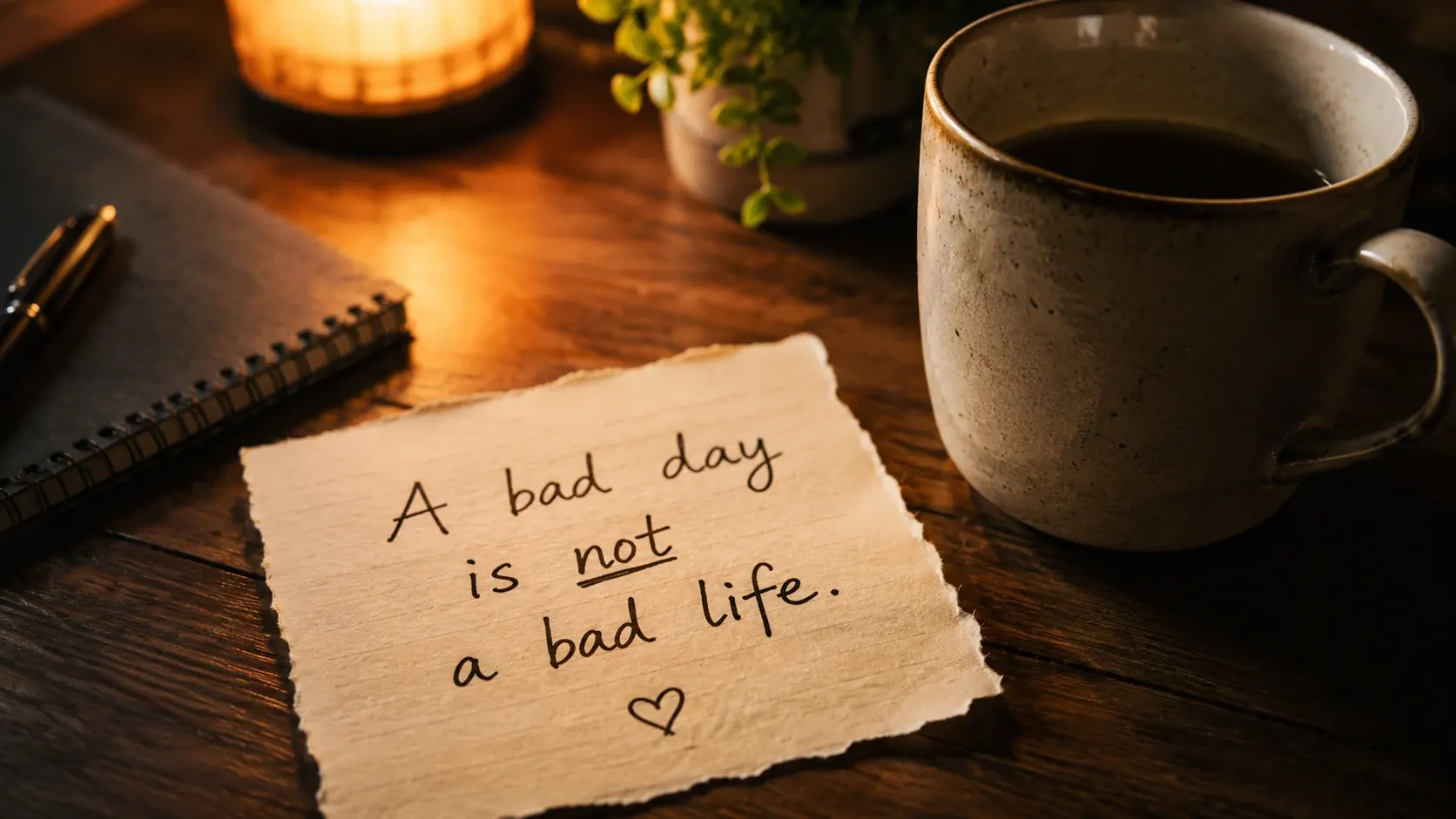
A bad day has a way of pretending it is more than a day. One mistake at work, one awkward conversation, one moment where your patience runs out, one shift where everything feels heavier than it should — and suddenly the mind starts building a whole case against you. It does not say, “That was a rough few hours.” It says, “This is who you are.” That jump is where self-worth gets dragged into court for something much smaller than a life verdict.
A bad day feels louder when it starts judging your whole identity; research on self-criticism and psychological flexibility keeps the focus on daily support instead of self-attack.
The danger is not the bad day by itself. Everyone has them. The danger is letting the day become a narrator. When tiredness, embarrassment, pressure, or disappointment starts telling the story, it usually leaves out context. It forgets sleep, workload, stress, hunger, money pressure, family tension, old fear, and the hundred small things a person was already carrying before the mistake happened.
The verdict arrives too fast
Bad days often produce fast conclusions because fast conclusions feel like control. If you can label yourself the problem, at least the chaos has a name. “I’m lazy.” “I’m stupid.” “I always mess things up.” “I can’t handle anything.” Those sentences sound final, and final can feel strangely safer than uncertainty. But a harsh label is not the same as truth. It is usually pain trying to simplify a messy situation.
A fairer reading starts with separating the event from the identity. The event may be real. Maybe you snapped. Maybe you forgot something. Maybe you wasted time. Maybe you handled a conversation badly. Owning that is useful. Turning it into a total description of your character is not useful. One moment can ask for repair without being allowed to rewrite your entire name tag.
The body may also be reacting to pressure, and NIH-hosted research on self-critical cycles helps explain how harsh inner patterns can keep repeating after the moment has passed.
What happened, what it means, and what it does not mean
One of the simplest ways to slow the spiral is to divide the story into three parts. First: what happened? Keep it plain, almost boring. “I missed the deadline.” “I bought food I did not plan to buy.” “I came home and did nothing.” Second: what does it mean practically? Maybe you need to apologize, adjust a system, sleep, prepare earlier, or make the next step smaller. Third: what does it not mean? It does not mean you have no future. It does not mean every effort is fake. It does not mean you are permanently behind.
That third part matters because shame loves exaggeration. It takes a specific problem and tries to turn it into a permanent identity. A bad shift becomes “I am bad at life.” A tired evening becomes “I have no discipline.” A mistake becomes “I knew I was never going to change.” The comeback begins when you refuse to let a single scene become the whole movie.
The after-work courtroom
For many people, the hardest part of a bad day is not what happened in public. It is the private replay afterward. You get home, sit down, and the mind starts replaying the exact tone, look, error, or missed chance. The body wants rest, but the inner courtroom opens. Prosecutor, judge, and witness all sound like you.
That is the moment to change the setting. Not with fake positivity, but with procedure. Eat something. Drink water. Change clothes. Step outside for five minutes. Write the event in one sentence. Then write one next action. The brain often needs a physical ending before it can stop treating the day like it is still happening.
Repair beats self-punishment
Self-punishment can feel responsible because it seems like proof that you care. But punishment without repair keeps the person stuck facing the wall. Repair turns the body back toward life. If you were short with someone, apologize clearly. If you forgot something, set a reminder. If you lost the evening, choose one small action before bed. If you overspent, look at the number without dramatizing it and decide the next boundary.
The point is not to erase the day. The point is to keep it the right size. A bad day can teach something, cost something, or require something. It does not get to become your biography.
Let the day end where it ends
A rough day deserves an ending. Not because everything is fixed, but because the person living through it still needs sleep, food, quiet, and a chance to begin again without carrying a fake life sentence. You can learn from what happened without letting it follow you into every room.
Tomorrow does not need you to arrive perfectly confident. It only needs you to arrive with the facts separated from the verdict. Something happened. Something may need care. But you are still more than the worst hour of the day.
It can also help to avoid making life decisions while the emotional dust is still in the air. A bad afternoon is not the best judge of your career, relationships, health, or future. Give the facts a night to cool down before deciding what the day supposedly means about you.
The calmer version of you may still choose to change something. That is good. But the change will come from repair instead of panic, and repair is usually where self-respect starts coming back.